Table of Contents
ToggleBuilding or buying a tiny home isn’t just about going small, it’s about getting the dimensions right. Too narrow, and you won’t fit a staircase. Too tall, and you’ll breach highway clearances or zoning codes. Too short, and you’ll sacrifice livable square footage. The difference between a cramped box and a functional micro-dwelling comes down to inches, not feet. Whether someone’s planning a wheeled tiny house or a foundation model, understanding standard dimensions, legal limits, and interior spatial requirements is the first step. This guide breaks down the numbers that matter, the codes that restrict, and the layouts that work.
Key Takeaways
- Standard tiny home dimensions range from 100–400 square feet, with wheeled models capped at 8.5 feet wide and 13.5 feet tall to meet road-legal towing limits.
- Tiny house on wheels (THOW) are constrained by Federal Highway Administration regulations, while foundation models offer greater flexibility in width (up to 16 feet) and height (typically 15–18 feet per zoning).
- Interior wall framing consumes 8–10 inches of usable space, so an 8.5-foot-wide trailer yields approximately 7.5 feet of actual interior width.
- Zoning and building codes vary significantly by jurisdiction; foundation tiny homes usually require full building permits, while THOW may need permits only when connected to utilities.
- Multi-function furniture, pocket doors, vertical storage, and circulation paths of 30–36 inches are essential strategies to maximize functionality within tiny home dimensions.
- Loft headroom should reach 36–42 inches at the peak for comfort, and sleeping lofts typically measure 6–7 feet wide by 8–10 feet deep.
What Are Standard Tiny Home Dimensions?
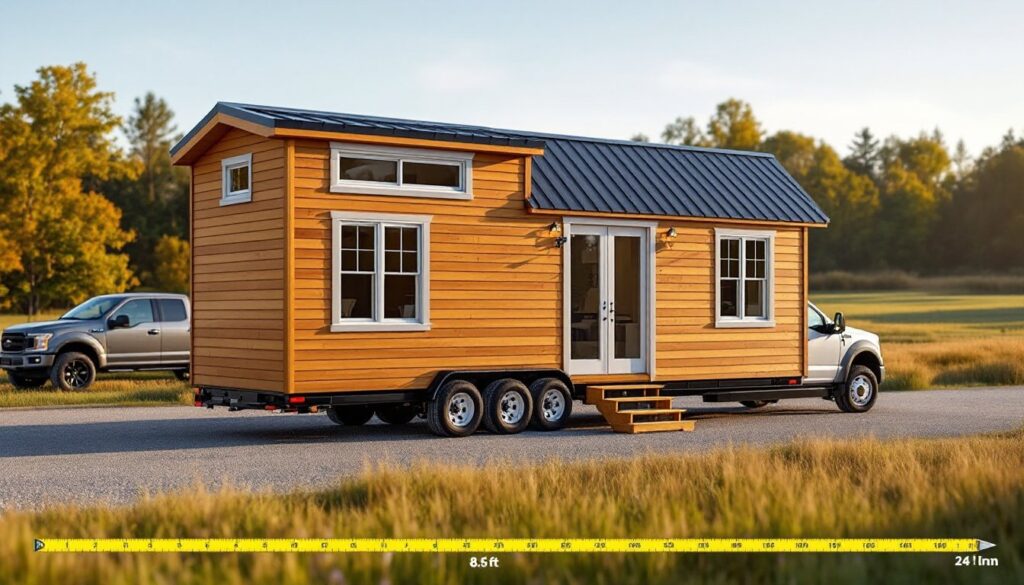
Most tiny homes fall between 100 and 400 square feet, though the definition isn’t legally standardized nationwide. Wheeled models typically measure 8 to 8.5 feet wide (the maximum for towing without a wide-load permit), 13.5 feet high or less (to clear most overpasses), and 20 to 28 feet long (though 32-foot models exist). Foundation-based tiny homes have more flexibility but still trend toward compact footprints to stay under local square footage thresholds for accessory dwelling units (ADUs) or to avoid triggering full residential building code requirements.
A common wheeled layout is 8.5 × 24 feet, yielding roughly 204 square feet of main-floor space. Add a sleeping loft and total usable area climbs to around 300 square feet. Foundation models often use 12 × 20, 14 × 24, or 16 × 20 footprints, offering between 240 and 384 square feet without lofts. These dimensions align with trailer bed widths (for THOW) or shed/garage foundations (for fixed builds).
Keep in mind that exterior dimensions differ from interior dimensions. Wall framing (typically 2×4 studs with sheathing and siding) eats 8 to 10 inches off width and length. A 8.5-foot-wide trailer yields an interior width closer to 7.5 feet once walls are up. Plan for usable space, not just the trailer deck measurement.
Tiny House on Wheels vs. Foundation: How Dimensions Differ
Tiny houses on wheels (THOW) are constrained by road-legal towing limits. The Federal Highway Administration and state DOTs cap non-permitted loads at 8.5 feet wide and 13.5 feet tall (measured from pavement). Length varies by state, most allow up to 30 feet for a bumper-pull trailer without special permits, though 24 to 28 feet is more common to improve maneuverability and reduce weight. Total weight should stay under the tow vehicle’s capacity, usually 10,000 to 14,000 pounds GVWR for a dual-axle trailer.
Height is a critical factor. A standard flatbed trailer sits 2 to 3 feet off the ground. Add a 10-foot wall and a pitched roof, and total height can hit 13.5 feet fast. That leaves little room for loft headroom. Many builders use a shed-style or low-pitch gable (3:12 or 4:12) to maximize interior ceiling height without exceeding the 13.5-foot cap.
Foundation tiny homes aren’t subject to towing restrictions, so width can expand to 12, 14, or even 16 feet. Height is limited only by local zoning (often 15 to 18 feet for accessory structures). Length is unrestricted, but most builders stick to 20 to 30 feet to keep material costs down and maintain the “tiny” ethos. Foundation models can use full 2×6 wall framing for better insulation (R-19 to R-21 vs. R-13 in 2×4 walls), a significant advantage in cold climates. They also support heavier finishes, tile, shiplap, full-size appliances, without worrying about road vibration or weight distribution.
Legal Size Requirements and Zoning Restrictions
Zoning is where tiny home dreams hit reality. Many municipalities define a dwelling as a structure with a minimum square footage, often 600 to 1,000 square feet, which automatically disqualifies most tiny homes from residential zoning. Others classify tiny homes as recreational vehicles (RVs), limiting where and how long they can be parked.
Some jurisdictions have carved out exceptions. ADU ordinances in California, Oregon, and Washington allow structures as small as 150 to 400 square feet on single-family lots, provided they meet setback, utility, and safety codes. Foundation tiny homes classified as ADUs must comply with the International Residential Code (IRC), including egress window sizes (5.7 square feet minimum), ceiling heights (6 feet 8 inches in habitable rooms, 6 feet 4 inches in bathrooms), and stairway dimensions (minimum 10-inch tread depth, 7.75-inch max riser).
THOW face steeper hurdles. The IRC Appendix Q (introduced in 2018) provides a code framework for tiny houses on foundations but doesn’t address wheeled models. The ANSI 119.5 standard (for park model RVs) caps size at 400 square feet and requires third-party certification, but it’s geared toward campground use, not permanent residency. Entrepreneurs interested in modern living solutions often find that local building departments lack clear guidance, forcing case-by-case reviews.
Permit reality: Foundation tiny homes usually require a full building permit if they’re classified as permanent dwellings. THOW may bypass permits if parked temporarily, but connecting to utilities (water, sewer, electric) often triggers permit requirements regardless of wheel status. Always check with the local planning department before breaking ground or parking a trailer.
Breaking Down Interior Space: Room-by-Room Dimensions
Bedroom and Loft Sizing
Most tiny homes use a sleeping loft to free up main-floor space. Standard loft dimensions run 6 to 7 feet wide (interior wall-to-wall) by 8 to 10 feet deep, yielding 48 to 70 square feet. Headroom is the squeeze: aim for 36 to 42 inches at the peak to allow sitting upright in bed. Anything less feels claustrophobic. Codes don’t classify lofts as habitable rooms if ceiling height stays below 6 feet 8 inches, so they’re exempt from egress window rules, but include ventilation (a small window or vent fan) for comfort.
Loft access eats space. A ship’s ladder or alternating-tread stair requires a 24- to 30-inch-wide footprint and 60 to 70 inches of vertical run. Standard stairs (IRC-compliant) need 36 inches wide and consume 9 to 11 feet of floor length at a 7.75-inch riser, which is tough to justify in a 200-square-foot floor plan. Many builders compromise with a sturdy ladder, accepting that it’s less kid- or senior-friendly.
Ground-floor bedrooms in foundation models work if total square footage exceeds 300. A 7 × 8-foot space fits a full or queen bed with minimal clearance. Code requires a 5.7-square-foot egress window if it’s a sleeping room, so plan window placement early. Closets can shrink to 24 inches deep with a tension rod, just enough for hanging clothes. Those focused on small space living often use under-bed drawers and wall-mounted hooks to avoid bulky dressers.
Kitchen and Bathroom Measurements
Kitchens in tiny homes range from 4 to 6 feet of linear counter space. A two-burner cooktop is 12 to 20 inches wide: an apartment-size fridge is 18 to 24 inches. Include a 20-inch-wide sink and you’ve filled 50 to 64 inches. Upper cabinets (12 inches deep) and base cabinets (24 inches deep) follow standard dimensions, but reduce cabinet runs to 3 to 4 feet per wall. An L-shaped or galley layout maximizes efficiency. Countertop depth should stay at 24 inches to allow workspace, even if it tightens circulation.
Include 18 inches of landing space beside the cooktop and sink per code (though inspectors rarely enforce this in certified tiny homes). Use a fold-down cutting board or pull-out counter extension if needed. Many builders skip dishwashers to save 24 inches of base cabinet width.
Bathrooms squeeze into 20 to 30 square feet. A standard shower stall is 32 × 32 inches (though 30 × 30 neo-angle models exist). Composting or incinerating toilets have a smaller footprint than traditional flush toilets and skip the black-water tank, a win for THOW. Wall-hung sinks (pedestal or bracket-mount) use less space than vanities. Building codes require 21 inches of clearance in front of the toilet and 15 inches from centerline to any wall, but many tiny home builders ignore this to fit a 24-inch-wide bathroom. If pursuing a legal ADU permit, respect code minimums.
Ventilation is non-negotiable. Install a 50-CFM exhaust fan ducted to the exterior. Moisture in a tiny, tight space causes mold fast. Those researching home organization strategies know that smart storage, medicine cabinets, corner shelves, magnetic strips, keeps tiny bathrooms functional.
How to Maximize Space Within Your Tiny Home Footprint
Start with multi-function furniture. A dinette booth with storage underneath, a Murphy bed that folds into a desk, or a couch with pull-out drawers can double usable space. Built-ins beat freestanding furniture every time, custom benches, window seats with lift tops, and floor-to-ceiling shelving units use odd corners and vertical height that IKEA can’t.
Vertical storage is king. Install shelves or cabinets up to the ceiling. Use the space above doorways for shallow cubbies. Mount bikes, kayaks, or ladders on wall tracks. In a loft, add cubbies along the knee walls (the short walls below the roofline) for shoes, books, or bins.
Pocket doors and barn doors save the 9 to 12 square feet a swinging door occupies. A 30-inch pocket door needs a 2×6 wall cavity, but it’s worth the framing cost. Barn doors work on 2×4 walls but project 2 inches into the room, fine for a bathroom, awkward for tight hallways.
Keep circulation paths at 30 to 36 inches wide. Tighter feels claustrophobic: wider wastes footage. In a galley kitchen, 36 inches between counters allows one person to work comfortably: 42 inches lets two pass without turning sideways.
Lighting matters more in small spaces. Use recessed LED pucks (2.5 to 4 inches diameter) to avoid head-bumping pendant lights. Under-cabinet strips brighten counters without stealing headroom. South-facing windows (or a skylight in the loft) bring natural light deep into the plan, making spaces feel larger.
Finally, edit ruthlessly. Tiny living works when every item earns its place. If something isn’t used weekly, store it off-site or donate it. The goal isn’t minimalism for aesthetics, it’s function within fixed dimensions.