Table of Contents
ToggleConverting a box truck into a tiny home offers a unique blend of affordability, mobility, and DIY potential. Unlike traditional RVs or travel trailers, box trucks provide a blank canvas with solid walls, ample headroom, and a surprisingly sturdy frame. They’re cheaper to acquire than new campers, easier to customize than repurposed school buses, and far more approachable for first-time builders. For anyone ready to tackle a mid-level DIY project with real payoff, a box truck conversion delivers livable square footage without the financing or permitting headaches of stick-built tiny homes.
Key Takeaways
- A box truck tiny home conversion costs $15,000–$30,000 all-in and takes 3–6 months, making it significantly cheaper than traditional RVs or site-built tiny homes while offering DIY customization.
- Box trucks provide 100–150 square feet of usable living space with 6’6″ to 7’2″ of headroom, flat ceilings, and vertical walls that simplify framing and maximize floor layout compared to school buses or van conversions.
- Used 16–20-foot box trucks are ideal for first-time builders, with a 16-foot model offering roughly 100–120 square feet of interior space once insulation and framing are installed.
- Proper insulation, ventilation with roof vent fans, and sealed seams are critical to prevent condensation damage and ensure livability in a box truck tiny home.
- Install a 12-volt DC electrical system with optional 120-volt AC inverter, plus PEX freshwater tubing and holding tanks for plumbing, following RV standards as a reference guide.
- Weight management and compliance with the truck’s GVWR are essential—factor in insulation, appliances, water tanks, and personal items to stay legal and maintain insurance coverage.
What Is a Box Truck Tiny Home?
A box truck tiny home is a cargo box truck, typically a 10- to 26-foot commercial vehicle, retrofitted with insulation, utilities, and residential finishes to create a self-contained living space. The box itself is usually aluminum or fiberglass over a steel or wood frame, mounted on a cab-chassis platform.
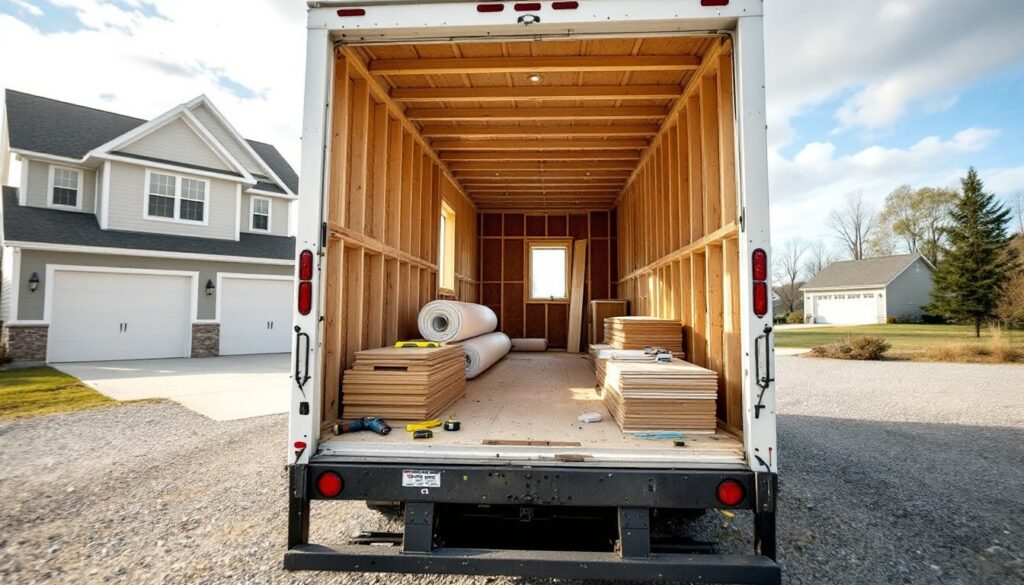
These trucks start life hauling freight, not people, which means they lack the plumbing, electrical, and HVAC systems found in factory-built RVs. That’s both the challenge and the opportunity. Builders gut the cargo area, frame interior walls using 2×2 or 2×3 lumber (actual dimensions 1.5″ x 1.5″ or 1.5″ x 2.5″), install rigid foam or spray foam insulation, and run DIY electrical and plumbing from scratch. The result is a mobile dwelling that can be registered as a commercial vehicle in most states, sidestepping some of the zoning restrictions that plague stationary tiny homes.
Unlike skoolies (converted school buses) or van conversions, box trucks offer vertical walls and flat ceilings, which simplify framing and maximize usable floor space. Headroom typically ranges from 6’6″ to 7’2″ depending on the model, and the cargo box is already weatherproof and lockable.
Why Choose a Box Truck Over Other Tiny Home Options?
Box trucks win on cost and practicality. A used 16-foot Isuzu NPR or Ford E-Series box truck in decent shape runs $8,000 to $15,000, well under the price of a comparable used RV or the chassis-plus-trailer cost of a custom tiny home on wheels. Mileage matters less than engine condition and rust: many commercial trucks are retired with low hours but high idle time.
The boxy cargo area also simplifies construction. Builders don’t wrestle with curved walls, wheel wells, or overhead storage bays. Framing is straightforward: attach furring strips or a full stud wall to the interior metal skin, leaving a gap for insulation and vapor barrier. Electrical conduit can be surface-mounted or run behind wall sheathing without cutting into structural ribs. For those exploring small space living ideas or apartment-scale layouts, the rectangular footprint translates easily to familiar floor plans.
Another advantage is towing capacity. Many box trucks have built-in Class III or IV hitches and can tow a small trailer or gear hauler, handy if the build becomes a mobile workspace or artist studio. Because they’re titled as commercial vehicles, annual registration fees are often lower than for RVs, and some states exempt them from personal property tax.
Finally, box trucks are less conspicuous. They blend into industrial or commercial areas where overnight parking is tolerated, and they don’t scream “I live here” the way a converted school bus might.
Finding and Preparing the Right Box Truck
Start with 16- to 20-foot cargo boxes if this is a first build. Anything shorter feels cramped once insulation and interior walls consume 4–6 inches of width and length: anything longer requires a Class B CDL in many states if the GVWR (Gross Vehicle Weight Rating) exceeds 26,000 pounds. Check the vehicle title and registration to confirm the GVWR before purchase.
Inspect the frame rails, crossmembers, and floor for rust or rot. Lift the truck and check for structural corrosion where the box mounts to the chassis. Surface rust on the exterior box is cosmetic: holes in the floor or sidewalls are deal-breakers. Test the engine and transmission under load, commercial trucks often idle for hours daily, which can mask wear.
Once purchased, strip the interior down to bare walls and floor. Remove any shelving, tie-down tracks, or E-track rails. Inspect the cargo box floor: many are 3/4-inch plywood over steel or aluminum crossmembers. If the floor is sound, reinforce it with additional 3/4-inch CDX plywood glued and screwed to create a level subfloor. If the floor is metal or damaged, sister in treated lumber joists and lay new plywood.
Seal every seam, rivet, and roof penetration with Dicor self-leveling lap sealant or equivalent. Box trucks aren’t designed for the thermal cycling of a dwelling, so factory seals often fail. Budget a full day for roof and sidewall inspection.
Selecting the Ideal Truck Size and Condition
For a solo dweller, a 14- to 16-foot box provides roughly 100–120 square feet of interior space after insulation and framing. Couples or those planning a full kitchen and bathroom should aim for 18 to 20 feet, yielding 135–150 square feet. Anything beyond 20 feet becomes harder to park and may require commercial parking permits in urban areas.
Engine choice matters. Diesel engines (Isuzu 4HK1, Cummins ISB) offer better fuel economy and longevity but cost more to repair. Gasoline V8s (Ford Triton, GM Vortec) are cheaper to maintain and easier to service at general repair shops. Expect 8–12 mpg loaded, regardless of fuel type.
Check the truck’s maintenance records. Fleet vehicles often have documented service histories, which is a green flag. Avoid trucks with rebuilt titles unless you can verify the scope of prior damage. Rust in the cab or cargo box frame is progressive and expensive to remediate.
Essential Design and Layout Considerations
Begin with a scale floor plan. Use graph paper or a free tool like SketchUp to map furniture, utilities, and circulation space. Allow 30 inches minimum for walkways: 36 inches feels comfortable. The galley-style layout, kitchen and bathroom on one side, sleeping and living area on the other, works well in 16-foot builds.
Weight distribution is critical. Box trucks are front-heavy when empty, and adding a rear-mounted water tank or bathroom can help balance the load. Check the truck’s GVWR and axle ratings. A typical 16-foot box truck has a cargo capacity of 3,000–4,500 pounds: factor in insulation, framing, appliances, water, and personal belongings. If the build exceeds the GVWR, the truck becomes illegal to drive and insurance may be voided.
Insulation choices affect both weight and R-value. Polyiso rigid foam boards (R-6 per inch) are light and easy to cut but must be covered with fire-rated sheathing per most building codes. Spray foam (R-6 to R-7 per inch for closed-cell) fills gaps and adds structural rigidity but costs more and requires professional application. Budget $800–$1,500 for spray foam in a 16-foot box, or half that for DIY foam board installation. Many builders exploring DIY furniture building guides also find that built-in benches and beds with storage compartments save weight and maximize space.
Ceiling height allows for overhead storage or a sleeping loft in some models. A 6’8″ interior after insulation and finish ceiling is enough for standing headroom: anything less requires creative use of low-profile furniture.
Ventilation is non-negotiable. Install at least one 14-inch roof vent fan (MaxxAir, Fantastic Fan) to exhaust moisture and cooking fumes. Add a passive intake vent near the floor on the opposite end to create cross-ventilation. Without airflow, condensation will rot framing and insulation within months.
Installing Electrical, Plumbing, and Climate Control Systems
Electrical systems in a box truck tiny home typically run on 12-volt DC for lighting and small devices, with an optional 120-volt AC inverter for larger appliances. A basic setup includes a 200–400 amp-hour lithium battery bank, a 3,000-watt inverter/charger, and a roof-mounted solar array of 300–600 watts. Wire the system using 10 AWG or 12 AWG stranded copper wire for 12V circuits, and follow NEC Article 551 (Recreational Vehicles) as a reference, even though most jurisdictions don’t require permits for mobile builds.
Run wiring inside walls before installing interior paneling. Use Romex (NM-B cable) for AC circuits if the truck will plug into shore power at RV parks. Mount a 30-amp RV-style inlet on the exterior for hookups. Include a main breaker panel and GFCI protection for wet areas (kitchen, bathroom).
Plumbing is simpler than in a stick-built home. Most builders use 1/2-inch PEX tubing for freshwater and 3/4-inch PVC or ABS for drain lines. Mount a 20- to 30-gallon freshwater tank under a bench or bed frame, and route 12-volt RV water pumps (Shurflo, Flojet) to a small sink and shower. Greywater drains into a separate 20-gallon holding tank: black water (if installing a composting toilet) is managed separately. Avoid running plumbing in exterior walls to prevent freeze damage.
For climate control, a mini-split heat pump (9,000–12,000 BTU) is the gold standard but draws significant power and requires either shore power or a large solar and battery system. Budget-conscious builders often rely on a 12-volt diesel heater (Webasto, Espar) for cold weather and a combination of roof vents and portable fans for cooling. Those referencing free DIY furniture plans may build insulated window coverings or thermal curtains to reduce heat gain in summer.
Safety note: Install a carbon monoxide detector and a propane/natural gas detector if using a gas stove or heater. Mount a fire extinguisher near the exit door. All electrical work should include proper grounding to the truck chassis.
Conclusion
A box truck tiny home isn’t a weekend project, but it’s achievable for a builder with basic carpentry and electrical skills, a willingness to research codes and systems, and realistic expectations about cost and timeline. Most builds take three to six months working part-time and run $15,000–$30,000 all-in, including the truck. The result is a mobile, customized living space that can be parked, relocated, and upgraded over time, without a mortgage or site-built permit headaches.